The Listening Grove · This Country of Ours
Chapter 6: How the Flag of England Was Planted on the Shores of the New World
A Charlotte Mason read-aloud lesson. Press play, with the lesson.
What is This Country of Ours Chapter 6, How the Flag of England Was Planted on the Shores of the New World, about?Parent review
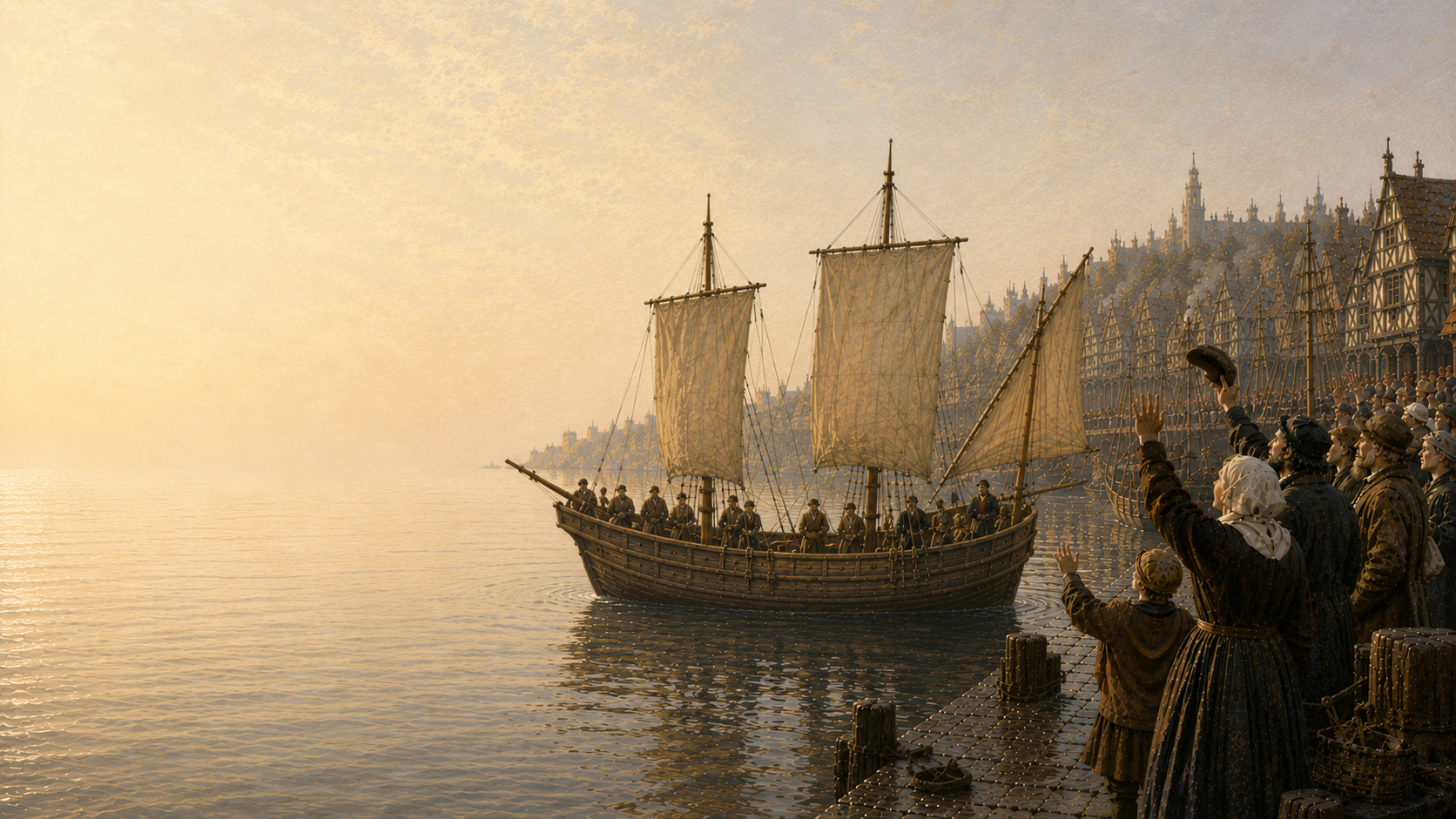
This Country of Ours Chapter 6, How the Flag of England Was Planted on the Shores of the New World, is the story of John Cabot. An Italian settled in the busy port of Bristol, Cabot took up the same idea as Columbus and went to Henry VII of England for help. The King was cautious with his money and granted him a patent but little else, so Cabot crossed the Atlantic in one small ship, the Matthew, with a crew of about eighteen men. He reached the coast of North America, went ashore, and set up a cross and the flag of England, naming the place Prima Terra Vista, the First Land Seen. He noticed the sea so crowded with fish that baskets weighted with stone came up full. He came home to a brief fame and a suit of silk, and sailed again the next year with a larger expedition. On that voyage the record gives out, and the story sails off into the fog.
Say what you remember!
Tell what you remember from the last chapter.
What happened in This Country of Ours Chapter 5, How America Was Named?Have a look
In Chapter 5, How America Was Named, we learned how two continents came to carry the wrong man's name. Many sailors followed Columbus west, among them Amerigo Vespucci of Florence, who went several times but never as leader, and whose lively accounts were widely read. A professor of geography published a little book proposing the name America after Amerigo, the map-makers took it up, and once it was on the maps nothing could get it off. Columbus was left with only a few places carrying his name, and nobody had planned it that way.
Read the previous lesson: How America Was Named →Show what you know!
Use your printable Lesson Guide. Fill in the vocabulary you know, then click to check your work and learn some new words today.
What are the difficult or advanced vocabulary words in This Country of Ours Chapter 6, How the Flag of England Was Planted on the Shores of the New World?thrifty, pension, godspeed, unfurlHave a look
- thrifty: careful with money and good at managing it
- pension: a sum granted regularly as a reward
- godspeed: a wish of success to someone setting out
- unfurl: to open or unroll something that was rolled up
Locate it on the map!
Use your printable Lesson Guide. Use an atlas and fill in the blank map if you can find the geographic location, then click to check your work.
What important geographic locations connect with This Country of Ours Chapter 6, How the Flag of England Was Planted on the Shores of the New World?
- Find
- England
- Ireland
- Newfoundland
- Labrador
- the Gulf of St. Lawrence
- Find and Label
- Bristol (England)
See it on the mapHave a look
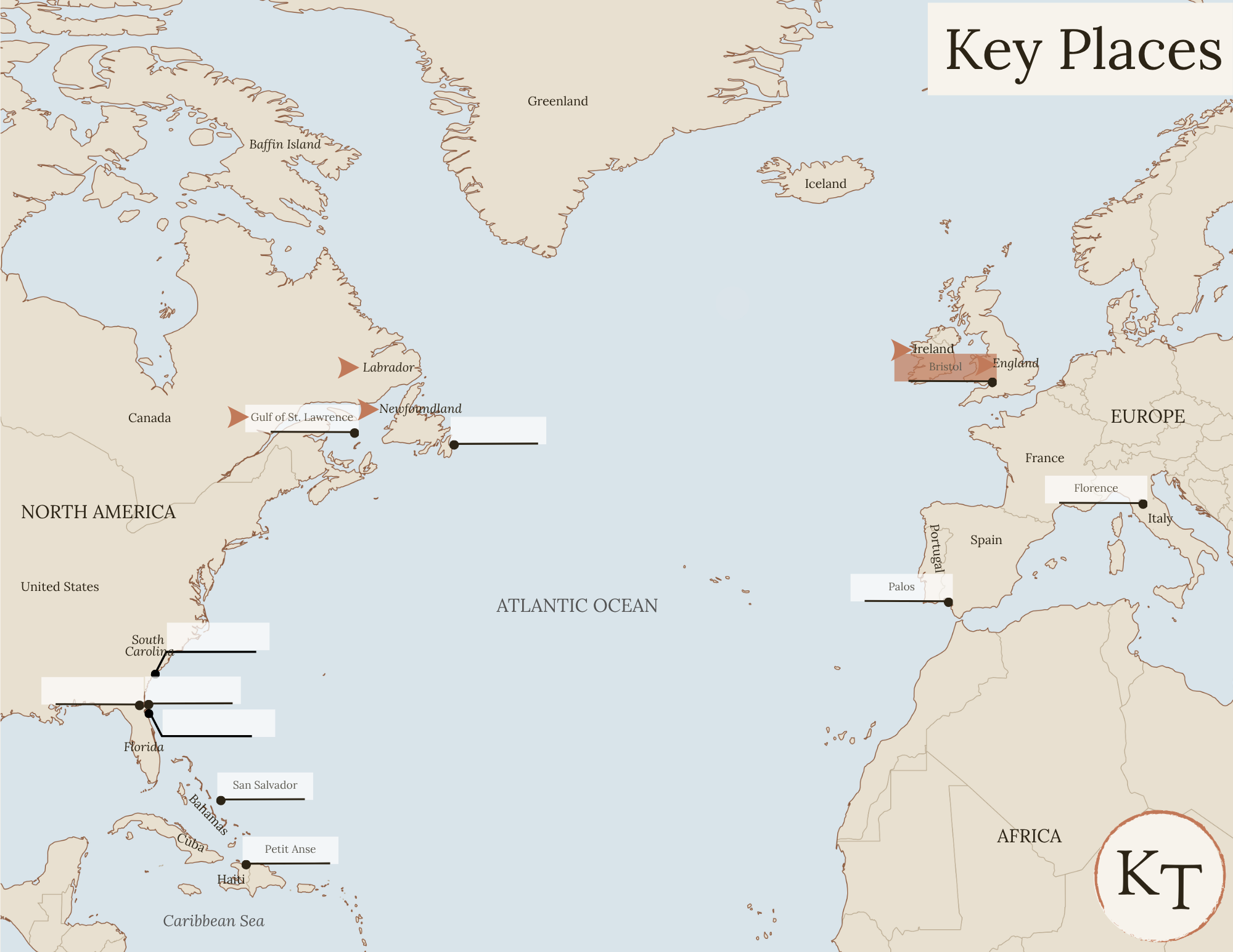
This matches the map in your Lesson Guide.
The Books come Alive!
Read or listen to Chapter 6 of This Country of Ours, the Kindred Thicket Revised Edition.
Read by Kindred Thicket from the This Country of Ours Kindred Thicket Revised Edition.
What corrections are made in Chapter 6 of This Country of Ours?Parent review
This is a Kindred Thicket Revised Edition. Factual and historical errors are corrected and dated wording is put right, and these notes tell you plainly what we changed and what we left as Marshall wrote it.
- About this sectionThroughout this section we brought Marshall’s British spellings to American English, keeping the original spelling inside quoted material.
- Kindred Thicket Revised Edition UpdatesIn This Country of Ours Chapter 6 we thoroughly examined and researched the chapter's contents. Two things needed our attention, and both are small. When Cabot came ashore he named the place Prima Tierra Vista, First Land Seen. Tierra is Spanish, and the phrase as it has come down to us is Latin, so the text now reads Prima Terra Vista. The meaning is unchanged. The second is a matter of punctuation rather than words. Henry VII's grant gives Cabot leave to plant England's banner on lands belonging to peoples outside the Christian faith, and in naming them the royal document of 1496 uses two words that carry a sharp religious judgment. Those are the document's words and not Marshall's own, so we put quotation marks around both to make clear whose voice you are hearing. Nothing was taken out, and the grant still says exactly what it said.
- Teacher's Notes“Like Columbus, Cabot was born in Genoa.”Cabot is said here to have been born in Genoa. His birthplace is disputed, and the claim rests on the word of his son Sebastian.
- “a frail little vessel called the Matthew, with a crew of but eighteen men”The Matthew is given a crew of eighteen. A Bristol merchant named John Day wrote at the time that there were twenty. The true number is not known.
- “he set out again across the broad Atlantic, taking his sons with him”Cabot's sons are named in the patent of 1496 but not in the one of 1498. Whether they sailed on the second voyage is still debated.
- “the first to plant the flag of England upon the Continent of North America”Cabot was the first to plant England's flag on North America. He was not the first European to reach it. Norse sailors had come and gone five hundred years before.
Memory becomes Action!
Use the Response Resource* to remember and spell tricky names. Choose one way to narrate.
*Materials in the Lesson Guide.
What is the list of names, people, characters, and places that are important in Chapter 6 of This Country of Ours?John Cabot, King Henry, The Matthew, Bristol, Genoa, Prima Terra Vista, St. John's Isle, EnglandHave a look
- John Cabot: An Italian sailor of Bristol, in the service of England.
- King Henry: The king of England, Cabot's thrifty patron.
- The Matthew: Cabot's ship, a small Bristol merchant vessel.
- Bristol: The English port Cabot sailed from.
- Genoa: The Italian city where Cabot, like Columbus, was born.
- Prima Terra Vista: Cabot's name for the land he sighted, meaning First Land Seen.
- St. John's Isle: Cabot's name for an island near his landfall.
- England: The kingdom whose flag Cabot planted in the New World.
Chapter 6 Q & A
This is a Kindred Thicket Revised Edition. Marshall’s 1917 history is beautiful but not always right, and here is what the record supports for this chapter.
Was John Cabot the first European to reach North America?
No. He was the first to plant England's flag on North America, which is a different claim. Norse sailors had come and gone five hundred years before, as Chapter 1 describes.
Where was John Cabot born?
His birthplace is disputed. Marshall says Genoa, like Columbus, but that claim rests on the word of his son Sebastian, so we left it and flagged it.
How many men sailed on the Matthew?
Marshall says eighteen. A Bristol merchant named John Day, writing at the time, said twenty. The true number is not known.
What does Prima Terra Vista mean?
First Land Seen. Marshall writes Prima Tierra Vista, but tierra is Spanish and the phrase as it has come down to us is Latin, so the text now reads Prima Terra Vista. The meaning is unchanged.
Did Cabot's sons sail with him?
It is still debated. His sons are named in the patent of 1496 but not in the one of 1498, so whether they were aboard the second voyage is not settled.
Why does the chapter end without saying what happened to Cabot?
Because the record itself gives out. He sailed on a larger second voyage in 1498 and what became of it is not known, which is why the story ends on a question mark.
What did Kindred Thicket change in this chapter?
Two small things. We corrected Prima Tierra Vista to its Latin form, and we put quotation marks around two words in Henry VII's grant of 1496 that carry a sharp religious judgment about peoples outside the Christian faith. Those are the royal document's words, not Marshall's own, so the marks make clear whose voice you are hearing. Nothing was taken out.